
12kW Hybrid PV System (with Net Metering) - Residential
- Type
- Residential
- Location
- Olongapo City
- System size
- 11.6 kWp
- Scope
- Designing, Supply, Installation & Commissioning

Switching to solar power in Olongapo City is one of the smartest ways to lower electric bills and protect your home or business from unexpected blackouts. A modern hybrid solar system does more than just produce daytime electricity—it stores power for the night and works together with the local electric grid.
Here is a straightforward look at how the main parts of this system work together:
1. Catching Sunlight (Bifacial Solar Panels)
The system uses special bifacial solar panels. Unlike traditional panels that only collect light from the top, these panels have glass on both sides. They catch direct sunlight from above while also absorbing light that bounces off your roof from below. This gives you extra power generation throughout the day, even on bright overcast afternoons.
2. Storing Power for Nighttime (Lithium Batteries)
Sunlight peaks during the middle of the day, but most energy is used in the evening. To solve this, the system includes two large Lithium Iron Phosphate (LiFePO4) batteries.
Daytime: Extra power from the sun automatically charges the batteries once your property’s immediate needs are met.
Nighttime & Outages: When the sun goes down or if the OEDC grid suddenly fails, the system switches to battery power instantly, keeping your lights, refrigerators, and air conditioners running without interruption.
3. Managing Power Flow (The Hybrid Inverter)
The hybrid inverter acts as the brain of the entire setup. It constantly checks where power is needed and routes it automatically:
It uses solar power first to run your appliances.
It sends extra solar energy to fill up your batteries.
If power runs out during a storm, it switches to backup battery power in a fraction of a second.
4. Selling Extra Power (Net Metering with OEDC)
Because this is a grid-tied system, it connects directly to the Olongapo Electricity Distribution Company (OEDC) through a two-way smart meter.
Once your batteries are completely full during sunny days, any leftover solar electricity you don't use gets sent back into the OEDC power grid. The utility company gives you credits on your monthly electric bill for this exported energy, significantly lowering your overall power costs.
Summary
By combining double-sided solar panels, large battery storage, and net metering, this hybrid system gives you 24/7 power security during brownouts and maximum savings on your monthly electricity bill.
Photos
-

Bifacial panels catch direct sunlight on the front and light reflected from the roof on the back -
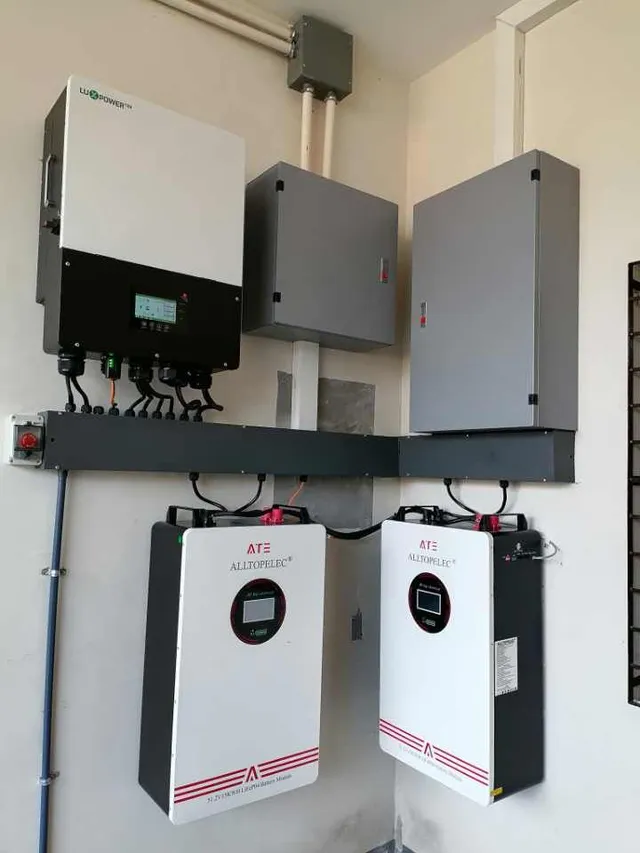
The heart of the system: the 12 kW hybrid inverter, the enclosures for the DC and AC protection devices, and two LiFePO4 batteries for the night and for outages -

Installing the rapid shutdown device (RSD): one action switches the solar panels on the roof down to a safe voltage -

The finished installation, connected to OEDC through a two-way meter for net metering
