
16kW Hybrid PV System - Residential, Imus
- Type
- Residential
- Location
- Imus, Cavite
- System size
- 18.9 kWp
- Scope
- Complete Package: Supply & Installation

The Orchard Golf & Country Club in Imus, Cavite is one of the high-end subdivisions in the province. Homes there call for a solar PV system that performs at a high level and looks as refined as the house itself. The owner, a doctor, drives a Tesla electric vehicle, and this system was built for one main purpose: to charge the car with the sun. JFL Solar & Renewables delivered a complete hybrid solar PV system package: we supplied all the equipment and installed the system.
The Solar Array
30 AE 630W bifacial PV modules make up a total array of 18.9 kWp. Bifacial modules collect sunlight on both sides: direct sunlight on the front, and light reflected from the roof on the back. With more panel capacity (18.9 kWp) than the inverter's 16 kW rating, the array keeps the inverter working closer to its full output for more hours of the day, including mornings, late afternoons and cloudy days.
A Big Risk: Right Beside the Golf Course
The house sits right beside the golf course, and that brings a risk most solar PV systems never face: stray golf balls. A driven golf ball travels very fast and carries many times more energy than the hailstones solar panels are tested against, so a direct hit can crack a module's glass.
- A cracked module loses output and lets moisture in over time, so it should be checked and replaced promptly.
- The inverter's monitoring app helps here: a sudden drop in a string's output is an early sign that a module may have been hit.
- A regular visual check of the array, especially on the side facing the course, is a good habit for this home.
- It is also worth asking the home insurer whether the solar PV system is covered for this kind of damage.
The Hybrid Inverter
The array feeds a 16 kW Solis hybrid inverter, the brain of the system. It decides every moment where the solar power goes: to the loads first, and any extra into the batteries. When the grid fails, it switches the backup loads to battery power automatically.
Battery Storage
Three Dyness PowerBrick 314Ah 51.2V LiFePO4 batteries store about 48 kWh of energy, a large energy reserve for a home. LiFePO4 (lithium iron phosphate) is one of the safest and longest-lasting battery chemistries, and each battery has its own battery management system (BMS) that protects the cells.
Charging a Tesla with Solar Power
An electric vehicle is one of the biggest energy users in a home, and every kilowatt-hour it takes from the grid shows up on the electric bill. With this system, the Tesla charges on clean energy from the owner's own roof instead.
- Daytime: when the car is plugged in while the sun is up, the 18.9 kWp array can supply the charging directly.
- Stored sunshine: solar energy saved in the 48 kWh battery bank can be used later, so the car can also be charged after sunset with solar power instead of grid power.
- Grid as backup only: the grid supplies power only when the sun and the batteries are not enough.
Driving on sunshine makes an electric car even cleaner, because the energy that moves it comes from the sun instead of the grid.
Premium Equipment for a Premium Home
- AE bifacial modules: high-output panels that also use light reflected from the roof.
- Solis hybrid inverter: one inverter that manages the solar panels, the batteries and the grid together.
- Dyness PowerBrick batteries: modern LiFePO4 batteries in a clean white design that suits a finished home.
A Clean, Safe Installation
Everything is wall-mounted in a dedicated equipment area behind sliding and louvered doors: the inverter between two steel enclosures for the DC and AC protection devices, a common cable trunking, and the three batteries below. A red emergency stop button lets the owner shut down the system safely in one press. The result is a neat, quiet installation that blends into the home.
How the System Works Every Day
- Daytime: solar power runs the loads directly, and the surplus charges the batteries.
- Evening and night: the batteries take over, so the home keeps running on stored solar power.
- Brownouts: the inverter switches the backup loads to battery power automatically.
Watch the Project
The video on this page shows the finished installation.
The result: a complete 16 kW hybrid solar PV system with about 48 kWh of battery storage that lets a doctor charge his Tesla with solar power, at his home in one of Cavite's high-end subdivisions, supplied and installed by JFL Solar.
Photos
-

A clean front view: inverter, cable trunking and the three batteries, built to charge the client's Tesla with the sun -
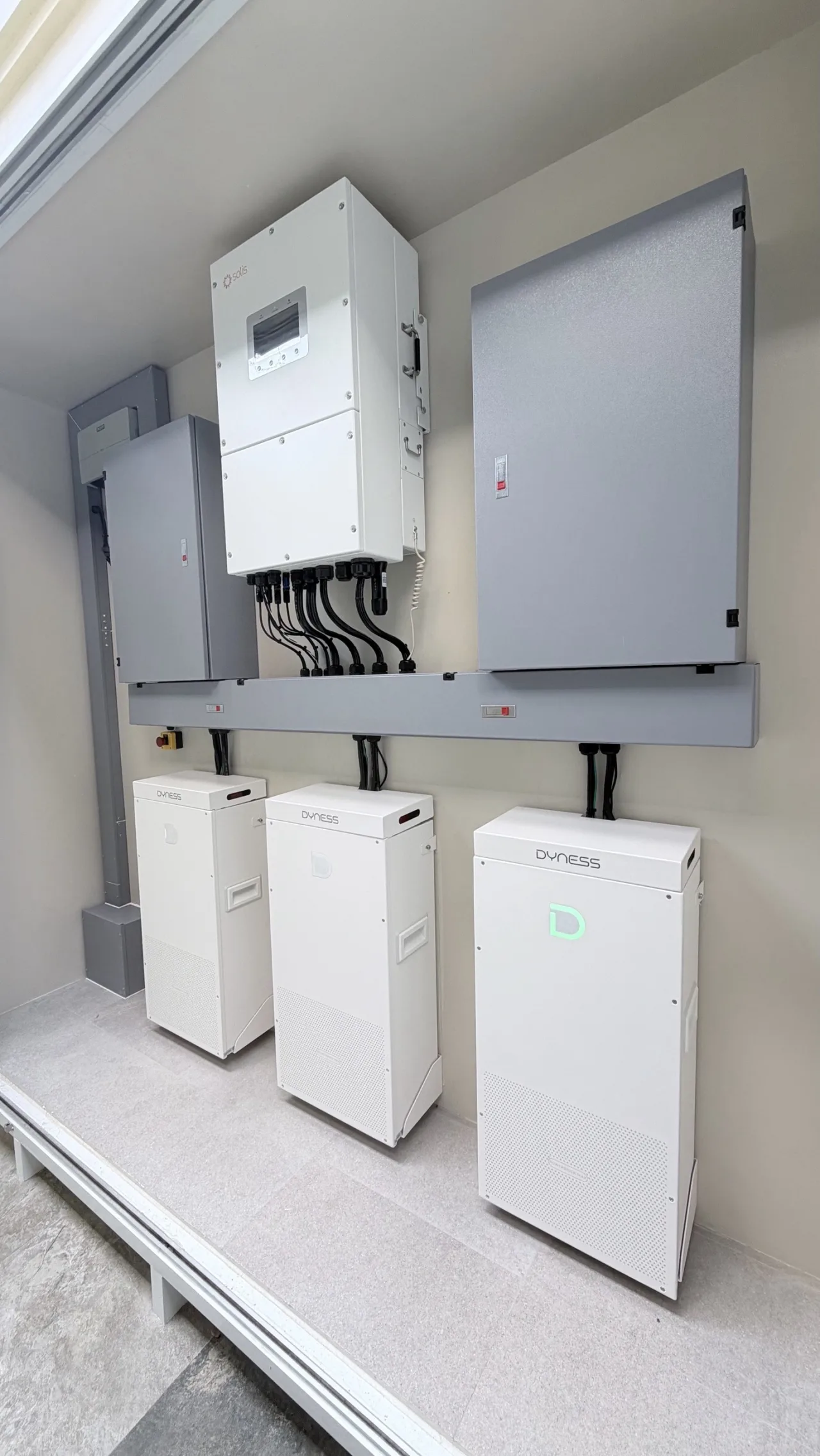
The equipment area of the home in The Orchard Golf & Country Club, Imus -

Three Dyness PowerBrick 314Ah LiFePO4 batteries connected below the Solis hybrid inverter
